Bring your own keys, or use ours.

Know when AI assistants mention your brand.

AI assistants are where recommendations happen now. CitePrism tracks whether ChatGPT, Claude, Gemini, Perplexity, Google AI Overviews, AI Mode and Copilot recommend you, who they recommend instead, which sources they trust, and what to do about it.

Free to start. Pro from $29 a month.

app.citeprism.com
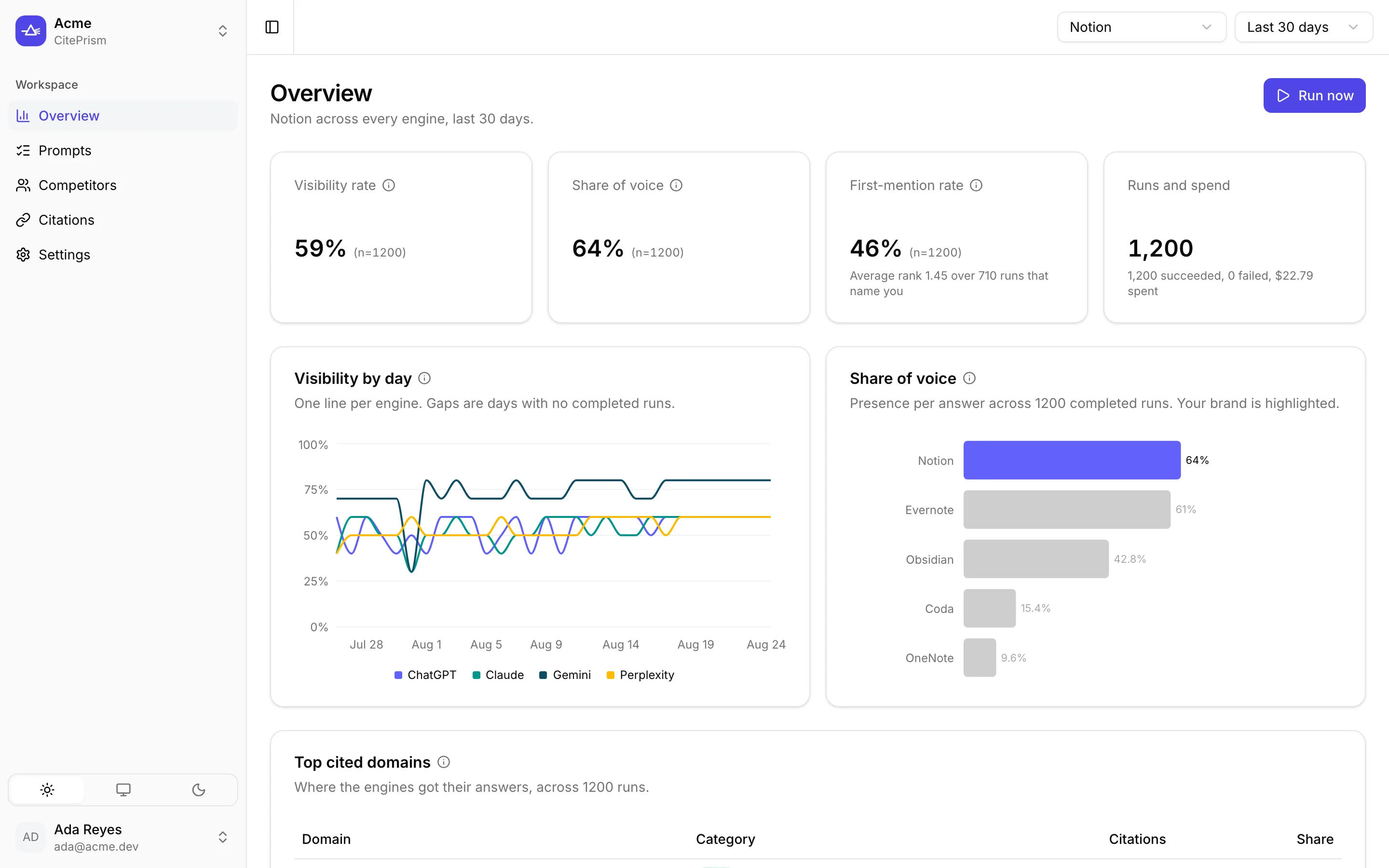
The CitePrism overview for a brand: how often it is named, share of voice against competitors, first-mention rate, a day by day chart per engine and the most cited domains

Listens to

  • ChatGPT The app, or the API with web search
  • Claude The API with web search
  • Gemini The app, or the API grounded in Google Search
  • Perplexity The app, or the API
  • Google AI Overviews No public API. Read from the product itself
  • Google AI Mode No public API. Read from the product itself
  • Microsoft Copilot No public API. Read from the product itself

ChatGPT, Gemini and Perplexity can be read from the apps people use, so you see the answer a person sees. Google AI Overviews, AI Mode and Copilot have no API, so that is the only way to read them.

Product

Your AI visibility, measured.

Visibility, share of voice and citations across every assistant, built from the real answers rather than a score pulled out of the air. Every metric is one click from the words it came from.

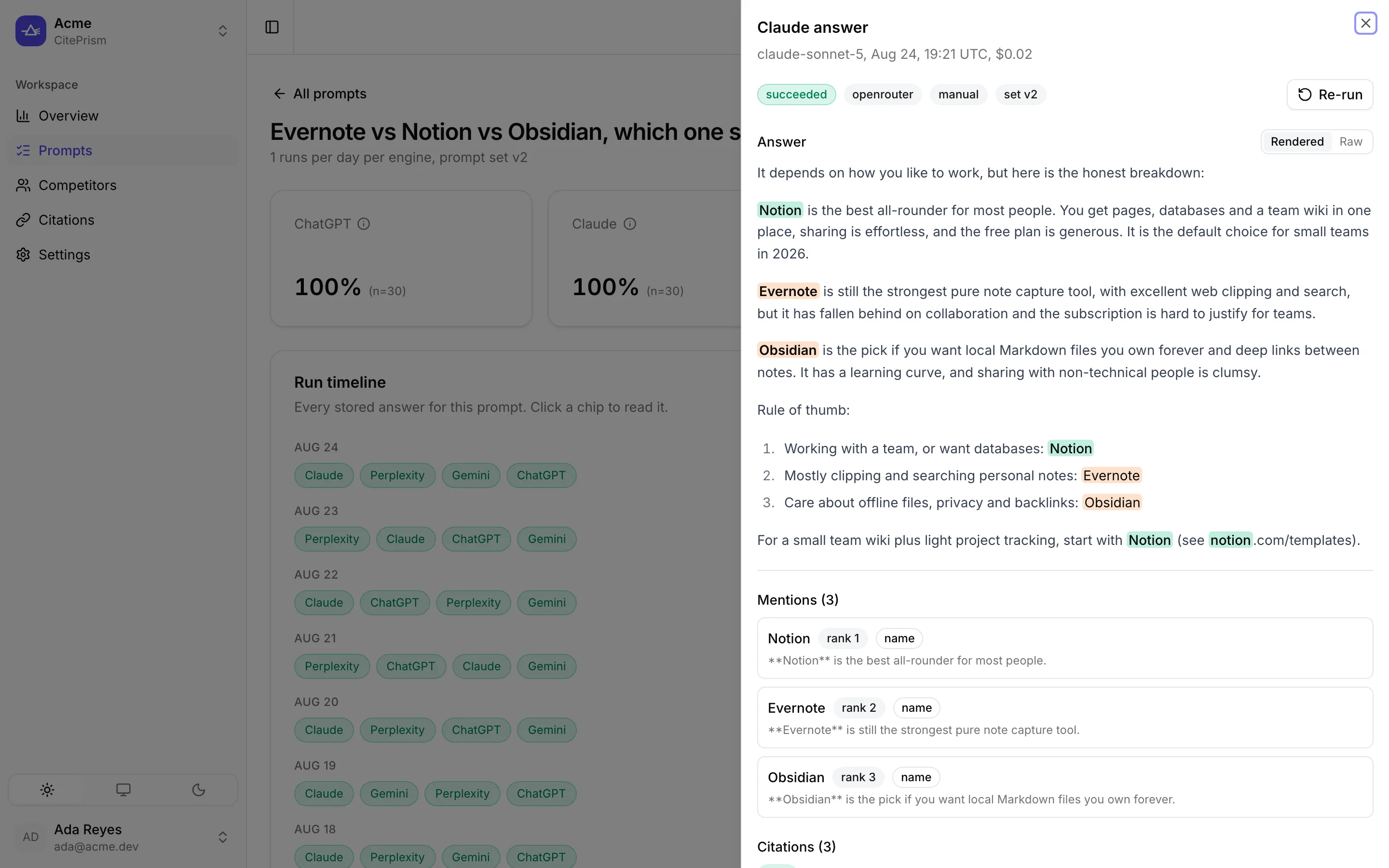
Read what the assistant actually said

Open any run and there is the full answer, word for word, with your brand and your competitors highlighted and the sources it leaned on listed underneath. Nothing is summarised away.

  • The full answer, as given
  • Your mentions highlighted
  • The sources it cited
  • What that answer cost you
A stored answer rendered as Markdown with the brand mentions highlighted and the cited URLs

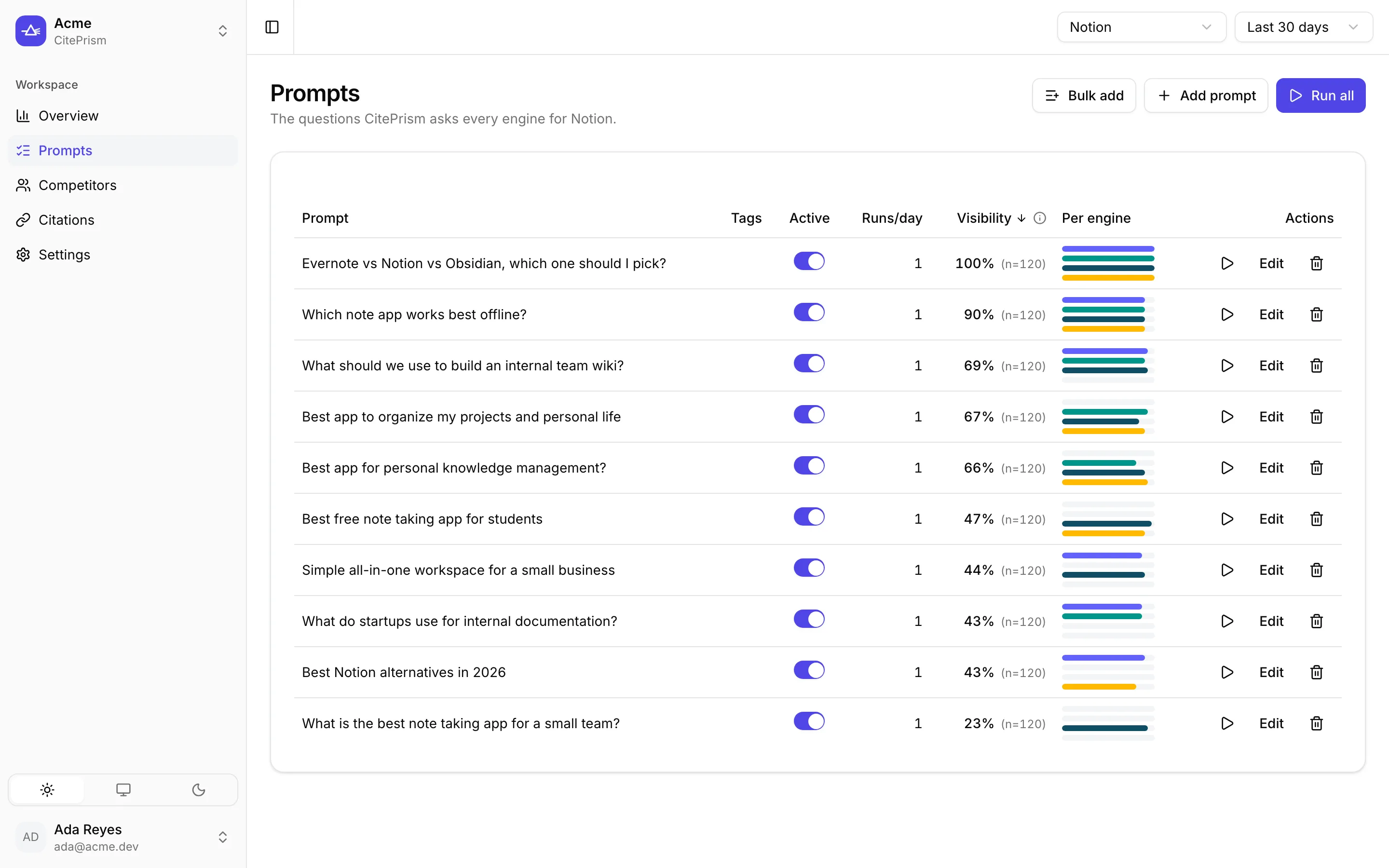
Numbers that lead somewhere

How often you are named, how often you are named first, how that differs by question and by engine, and whether it moved since last period. Click any number and you land on the answers behind it.

The questions table with how often the brand is named per question and per engine

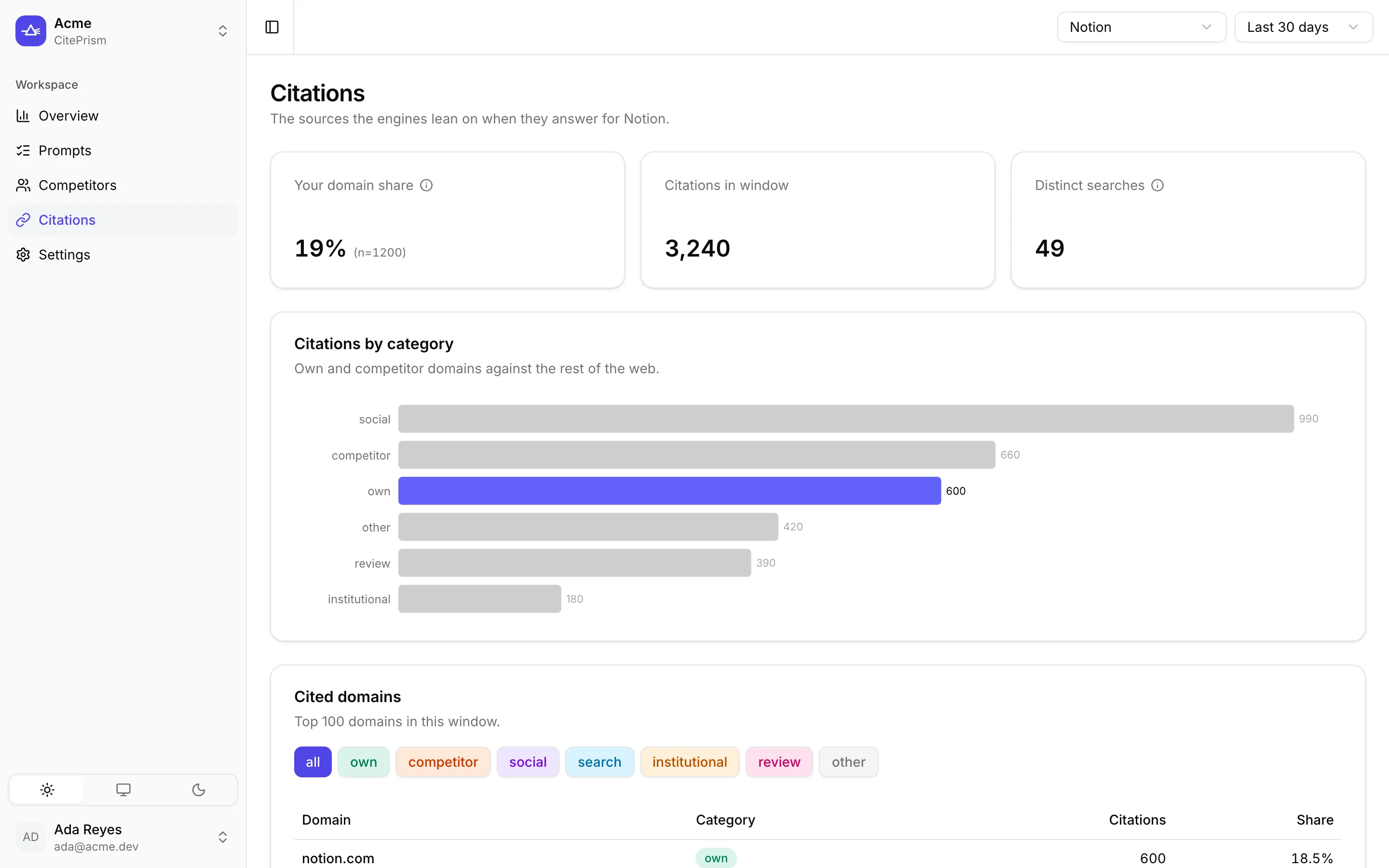
See where the answers come from

The sites the assistants cite when they talk about your category: yours, your competitors, review sites, communities. You learn who is shaping the story, and whether you are in it.

The citations page listing the most cited domains in the category, bucketed by type

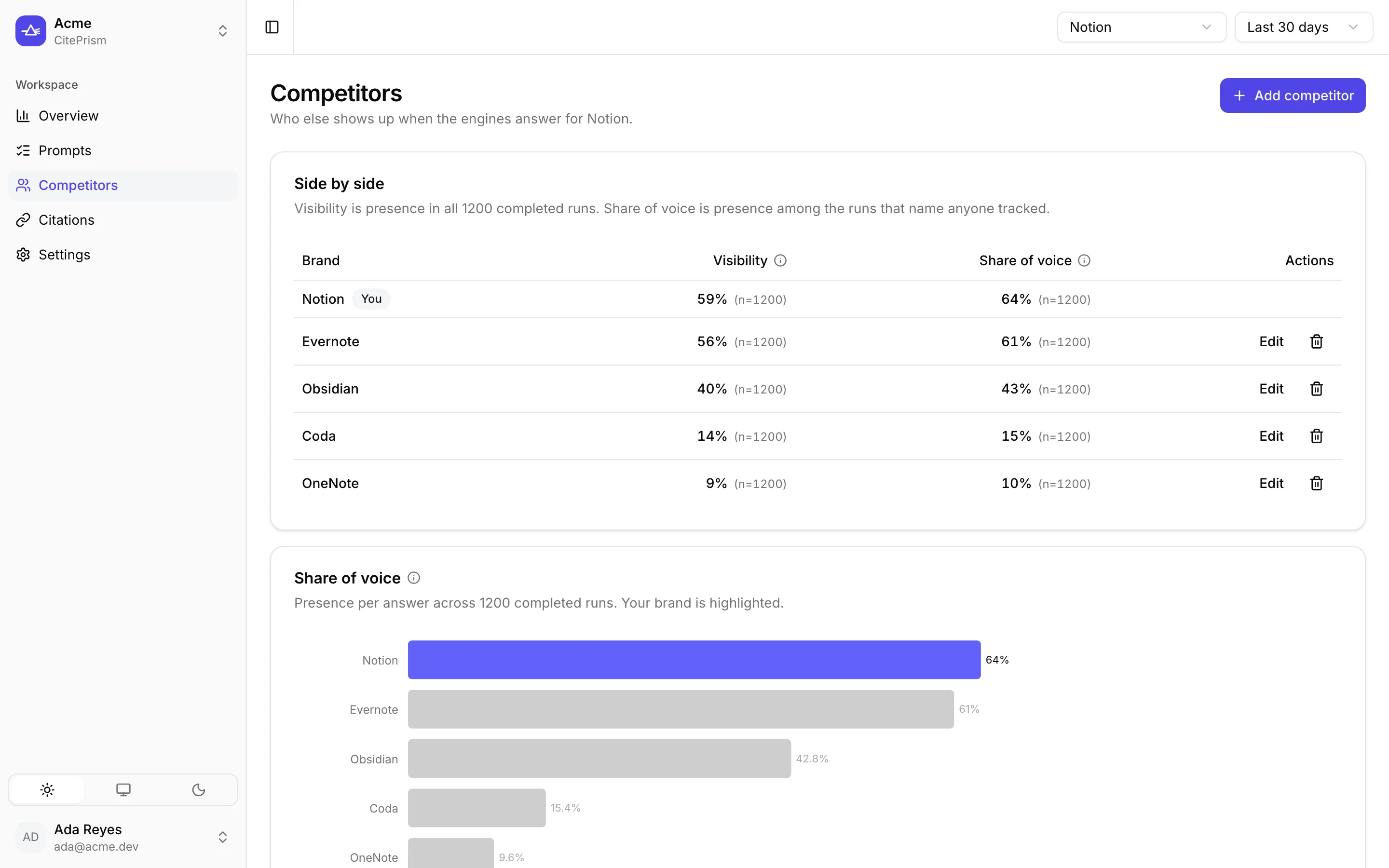
Competitors, side by side

Add the brands you lose deals to and see how often they show up in the very same answers as you. Share of voice from one set of questions, with no extra work.

The competitors page comparing how often the brand and each competitor are named

Guidance

Know what to fix, not just what happened.

01

Gaps

Every question where a rival is named more often than you, worst first, with the sources those answers cited and the rival pages the engines link to.

02

Queries

What the engines searched for before they answered. The words they add to your prompts are the modifiers buyers use. Track any search as a prompt in one click.

03

Opportunities

Every week, a short action list written from your last 30 days of answers: what to create, what to improve, where to get listed, where to show up. Each item is tied to the prompts it helps.

04

Weekly digest

Every Monday, per brand: visibility and share of voice with the change since last week, new gaps and searches worth tracking. Opt out per email type, never all or nothing.

How it works

Up and running in minutes.

  1. 01

    Add your brand

    Paste your website. CitePrism drafts the questions your buyers are likely asking and the competitors they compare you with. Keep what fits, change the rest. Ask for more prompt ideas any time.

  2. 02

    Let it run

    CitePrism asks every engine on a steady schedule, from the apps people use where it can, and keeps each answer. You set a daily spend limit, so the bill stays predictable.

  3. 03

    Watch your visibility move

    Within days you can see which assistants recommend you, where a competitor wins, and which pages earn the citations. Every number links to the answers behind it, so you know what to fix and can prove it moved. Gaps and the weekly digest tell you what to fix first.

What it measures

Straight about what it measures. It samples the assistants. It does not read your customers' minds.

CitePrism asks the questions itself

Every number comes from answers CitePrism collected, on a schedule you control, with the sample size shown right next to it. Small samples are marked as small, not dressed up as trends. Every rate greys out below ten answers. Read it as a clear, repeatable signal about how the models talk about your category.

Nobody can see real conversations

No AI provider exposes what people actually type. Anyone selling "real AI search traffic" is guessing from referrals. CitePrism will not pretend otherwise, and every definition it uses is documented on this page before you trust a number.

Pricing

Start free. Pay when it earns it.

Every engine and every feature on your own keys for nothing, or let Pro run it on ours.

Free

$0 forever

No card needed

Every engine and every feature, on your own keys.

  • Bring your own keys
  • All 7 engines, including Google AI Overviews, AI Mode and Copilot
  • Gaps, search queries, weekly action list and digest
  • 1 brand, 25 prompts, 5 competitors
  • 1 run a day
  • CSV export

Pro

7 day free trial

$29 a month

$299 a year saves you 2 months

Runs on our keys, so there is no API console to set up.

  • Runs on our keys, with daily usage included
  • No provider accounts to set up
  • Or bring your own keys to run past the allowance
  • 5 brands, 100 prompts, 25 competitors
  • Up to 4 runs a day
  • Priority support

Card required. Nothing charged for 7 days.

Custom

Contact

Quoted in writing

For teams that need more room than Pro, or a purchase order instead of a card.

  • Higher limits
  • Invoicing and purchase orders
  • Onboarding help from a person

Questions

The questions people ask first.

Short answers here. Each one links to the page that goes deeper.

What is AI visibility?

AI visibility is how often, how prominently and how favorably AI assistants mention your brand when people ask them about your category. Where search rankings measured your position on a results page, AI visibility measures whether you are inside the answer at all. It is tracked with a fixed set of buyer questions, sampled on a schedule, and turned into visibility rate, share of voice, rank and citation metrics.

Read the full definition

How do I check what ChatGPT says about my brand?

Write 15 to 25 questions the way a buyer would ask them, ask each one several times in fresh chats, and record whether you were named, in which position, which competitors appeared and which sources were cited. One answer tells you almost nothing because assistants answer differently every time. CitePrism runs that loop for you every day and stores every answer.

The step-by-step method

Does CitePrism see what people actually ask ChatGPT?

No, and neither can any other tool. Conversations with assistants are private and no provider exposes them. Every AI visibility tool measures by sampling: asking the assistants your category questions repeatedly and analyzing the answers. CitePrism says so plainly, shows the sample size next to every number, and greys out rates below ten answers.

What these tools actually measure

Which AI engines does CitePrism track?

CitePrism tracks seven engines: ChatGPT, Claude, Gemini, Perplexity, Google AI Overviews, Google AI Mode and Microsoft Copilot. The four with a public API are sampled through the API, and the others are read from the product itself so you see the answer a person sees. Every engine is available on the free plan with your own keys.

ChatGPT brand monitoring

What is share of voice in AI answers?

Of all the brand mentions across the sampled answers to your prompt set, share of voice is the fraction that are yours. CitePrism computes it per engine and overall, next to visibility rate, average rank and first-mention rate, with you and your competitors scored against the same questions on the same schedule.

LLM share of voice tracking

Why do the sources AI assistants cite matter?

Because they are the pages shaping your category. When an assistant answers with citations, it names the review sites, communities, documentation and competitor pages it trusts. CitePrism collects those citations from every sampled answer and groups them by category, which turns a visibility problem into a list of places to show up.

AI citation tracking

How does CitePrism compare with Profound, Peec AI or Otterly?

They track the same thing. CitePrism differs in what you can see and what you pay: every chart clicks through to the raw answers, every metric definition is published, the cost of every run is on screen, and sampling can run on your own keys at provider price. Profound wins on managed onboarding, SSO and executive reporting; Peec AI and Otterly win on being polished, simple products that someone else maintains. The comparison pages say so in their own rows.

Side-by-side comparisons

Is CitePrism free to start?

Yes. The free plan has every engine and every feature on your own API keys, with no card and no expiry. Pro is $29 a month or $299 a year and runs on our keys with daily usage included. Sampling on your own keys costs about five cents per prompt across the four API engines on their default models, paid to the providers.

Pricing and worked examples

See where you stand in AI answers.

Add your brand and within minutes you know where you are recommended, where a competitor wins, and what to fix first.